The Farmer Who Needed Less Water
Chapter One of The Future We Didn't See Coming. A third-generation farmer running out of water, a data center going up down the road, and an unlikely question: could the technology she fears help her save her land?
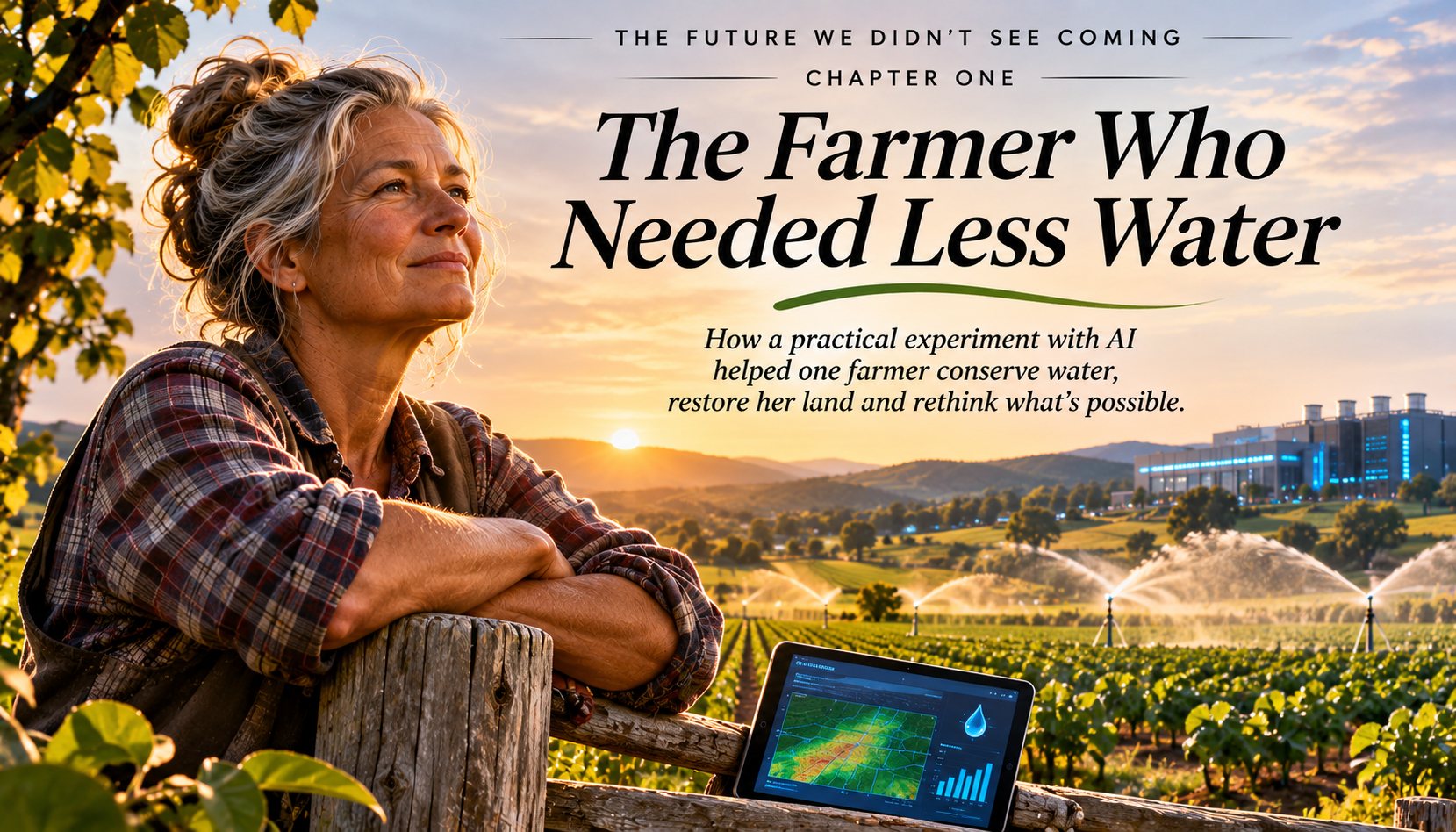
Eleanor Bennett stood at the edge of a field her grandfather had planted more than seventy years earlier. She pushed the toe of her boot into the dry soil, watching it crumble into dust.
Her grandfather used to tell her that the land would take care of her if she took care of it. Lately, she wondered whether the land was capable of keeping its end of the bargain.
The winters had become unpredictable. The summers seemed longer. Water allocations had been reduced again, and the cost of nearly everything required to operate the farm had increased.
She had already sold a piece of the southern pasture to a developer. It was a decision she regretted every time she drove past the new houses.
Now she was considering selling another.
At fifty-six, Eleanor wasn't afraid of hard work. She was afraid that hard work was no longer enough.
A new neighbor
Several miles down the road, construction had begun on an enormous data center.
The announcement had divided the community. Local officials celebrated the investment, promising jobs and additional tax revenue. Others questioned why a facility requiring so much electricity and water was being built in a region already struggling to provide enough of either.
Eleanor attended a town hall meeting on a Thursday evening.
"My family has been farming here for three generations," she told the officials seated at the front of the room. "You're telling me I need to use less water while approving a facility that will consume more. Help me understand how that makes sense."
The audience applauded.
The officials explained that the facility would use modern cooling systems, that its water requirements would be monitored and that the economic benefits would extend throughout the community.
Eleanor had heard enough promises from people who had never depended on a harvest.
A man seated near the end of the table asked for the microphone.
His name was Daniel Mercer. He was in his mid-forties, dressed in jeans and a slightly wrinkled button-down shirt. The company developing the data center had hired him several months earlier to work with the local community.
"I don't think Eleanor's question has been adequately answered," he said.
Several of the company representatives turned toward him.
"We can spend the evening discussing how efficiently this facility will operate, but that doesn't address the problem she's facing. Her farm needs water. So does this facility. Telling her that our consumption will be relatively efficient doesn't make more water available to her."
Eleanor folded her arms.
At least someone understood the question.
"I've been researching another possibility," Daniel continued. "There are agricultural researchers experimenting with artificial intelligence to improve irrigation, understand soil conditions and reduce water consumption. What I haven't been able to establish is how much of that research could be applied to farms in this community."
He looked toward Eleanor.
"And I can't establish that sitting behind a computer."
"Then what are you proposing?" she asked.
"I'd like to work with some local farmers. Not to teach them how to farm, but to investigate whether we can help them address the problems they're already facing."
"And who's paying for that?"
"The company building the data center has allocated funding for community outreach. I'd like to use some of that funding to actually solve problems rather than simply explain why people shouldn't be concerned about them."
A few people laughed. One of the company representatives shifted uncomfortably in his chair.
Eleanor wasn't laughing.
"What happens if you find out your computers can't help us?"
"Then that's what I'll report."
"And they'll be happy with that?"
"I suppose we'll find out."
For the first time that evening, Eleanor smiled.
An invitation
After the meeting, Daniel found Eleanor near the exit.
"I'm organizing a brainstorming session at the library next Saturday," he told her. "I'm inviting people from different professions to explore how artificial intelligence might help them with everyday conversations, managing their businesses, marketing and solving problems."
Eleanor shook her head.
"I'm not much interested in learning how to talk to a computer."
"That's fine. I'm more interested in learning why your farm is struggling with water."
"I just told you why. There isn't enough of it."
"Is that the entire problem?"
She looked at him.
"What do you mean?"
"Are there crops you could grow that require less water? Are there ways to retain more moisture in the soil? Are there parts of your farm receiving more water than they need while others aren't receiving enough? I don't know the answers to those questions."
"Neither does your computer."
"Probably not. But between your experience, the agricultural research that's available and the ability to examine all that information, we might discover something neither of us has considered."
Eleanor glanced toward the parking lot.
"I don't have money to spend on consultants."
"I'm not asking you for money. The outreach funding covers my time, and if we find something worth testing, I'll see what resources we can secure to help you."
"And I don't have much time."
"I understand. Give me an hour. Bring a problem you haven't been able to solve. If we can't identify anything worth investigating, you never have to see me again."
She considered the offer.
"What do you get out of it?"
"Hopefully, a better understanding of whether this technology can actually help people. I need people like you to find that out."
He handed her a card.
Eleanor put it in her coat pocket.
She still wasn't convinced.
But an hour seemed a reasonable investment if there was even a possibility of saving the farm.
The brainstorming session
The following Saturday, Eleanor found herself sitting in the library's small conference room alongside a dozen other people.
There was a plumber still wearing his work boots, a woman who operated a small handmade products business, a retired schoolteacher and a man carrying a folder of drawings for a product he hoped to manufacture someday.
They had little in common professionally, but each had arrived with a problem.
Daniel stood at the front of the room.
"Before we begin, I'd like everyone to understand something. This isn't a class on artificial intelligence. It's a brainstorming session."
He looked around the room.
"I'm interested in what happens when people with different experiences, different abilities and different problems begin exploring what this technology can do for them."
He began with a simple conversation.
He asked the artificial intelligence to help him understand why a fictional small business was struggling to attract customers. As it asked questions, Daniel supplied additional information. The conversation moved from marketing to pricing, customer relationships and operating expenses.
Then he demonstrated how the same technology could help someone organize their finances, prepare for a difficult discussion or investigate an unfamiliar subject.
The people in the room began offering suggestions.
The plumber asked whether it could help him understand what it would cost to operate his own business.
The woman selling handmade products wanted to know whether it could help her advertise without hiring a marketing company.
The man with the drawings asked whether it could help him find someone to manufacture his invention.
Daniel wrote each question on the whiteboard.
"I don't know whether artificial intelligence can solve all of these problems," he said. "But I think they're worth investigating."
He handed everyone a sheet of paper.
"Write down something you want to accomplish but haven't been able to. Don't worry about whether artificial intelligence can help. Just tell me what stands between you and what you want."
Eleanor wrote four words.
Not enough damn water.
When Daniel reached her table, he pulled up a chair.
"Tell me about your farm."
For the next forty minutes, Eleanor explained the soil conditions, the crops she grew, the irrigation system her father had installed and the changes she had observed over the years.
Daniel asked about rainfall, planting schedules, crop rotation, water pressure and how she determined when to irrigate.
"Experience," she answered.
"That's valuable. Do you keep records?"
She laughed.
"Three generations of them."
Daniel's expression changed.
"Would you be willing to let me see them?"
"What for?"
"Most of the research I've been reading is based on experiments conducted under specific conditions. Different soil, different climates, different crops. Your records could help us understand which of those findings might actually be relevant to your farm."
Eleanor considered this.
For years, people had been telling her that she needed to modernize her operation. They had recommended expensive equipment, new irrigation systems and agricultural products she couldn't afford.
Daniel was the first person who seemed interested in what she already possessed.
"Come by Tuesday," she said. "I'll put some coffee on."
Three generations of knowledge
On Tuesday morning, Daniel arrived at the farmhouse.
Eleanor led him into a small office that smelled of old paper and coffee. Shelves were filled with notebooks, binders, receipts and agricultural reports.
Her grandfather had recorded planting dates and harvest quantities. Her father had added irrigation schedules and fertilizer applications. Eleanor had continued the tradition, documenting nearly everything she considered important.
Daniel picked up one of the oldest notebooks.
"Do you realize how valuable this information might be?"
"My grandfather would have told you it was worth about seventy-five cents. That's what he paid for the notebook."
Daniel laughed.
"Researchers spend years trying to collect information like this. You've got decades of it."
Over the following weeks, Daniel spent several afternoons helping her digitize the records. They supplemented them with historical weather information, soil maps and agricultural research from universities.
Eleanor expected the computer to tell her how to run her farm.
Instead, it began asking questions.
Why were two fields receiving similar amounts of water when their soil composition differed considerably?
Why had certain crops performed better during particularly dry years?
Why were irrigation schedules based primarily on time rather than soil moisture?
Had she considered whether some of her cover crops could improve water retention?
Some of the observations were useful. Others were ridiculous.
One recommendation suggested planting a crop that Eleanor knew would struggle in the region's climate.
"That's not going to work," she told Daniel.
"Then tell it why."
She explained the local conditions, the temperature fluctuations and what had happened when her father had experimented with a similar crop decades earlier.
The recommendations changed.
For the first time, Eleanor began to understand what Daniel meant.
The computer didn't know her farm better than she did. But it could help her examine more research, compare more variables and explore more possibilities than she had time to consider.
And she knew things the computer didn't.
Perhaps there was something valuable in bringing the two together.
A small experiment
Eleanor refused to risk an entire growing season on an unproven idea.
Instead, she selected two comparable sections of a field.
One would continue using her established growing methods. The other would become an experiment.
Daniel secured a modest amount of funding through the data center's community outreach program to purchase soil moisture sensors and cover the initial testing expenses.
He also introduced Eleanor to an agricultural extension specialist who agreed to help evaluate their proposed experiments.
Together, they installed the sensors and began adjusting the irrigation schedule.
Eleanor experimented with different mulches, planting arrangements and cover crops. She began monitoring soil temperature and moisture at different depths rather than relying entirely on the appearance of the plants.
The artificial intelligence helped her interpret the measurements, compare them with agricultural research and anticipate changes in weather.
It didn't operate the farm.
Eleanor did.
During the first summer, several recommendations failed to produce the expected results. One sensor malfunctioned. A change to her irrigation schedule left a section of plants visibly stressed, forcing her to intervene.
One afternoon, Eleanor called Daniel in frustration.
"Your computer is trying to kill my tomatoes."
"What's happening?"
"The soil moisture readings say they have enough water, but the plants are telling me otherwise."
"Which do you trust?"
"The plants."
"Then water the tomatoes. We'll figure out why the readings are misleading afterward."
There were evenings when she regretted starting the experiment.
But there were also discoveries.
She found that some areas were receiving more water than the plants could effectively use. Other areas benefited from shorter, more frequent irrigation cycles. Certain planting arrangements appeared to protect the soil from excessive heat.
By the end of the season, the experimental section had produced a comparable harvest using less irrigation water.
It wasn't a revolutionary breakthrough.
It was enough to make her try again.
The second summer
Over the winter, Eleanor and Daniel reviewed the results.
They examined which changes appeared to work, which had failed and which required further testing.
The following spring, Eleanor expanded the experiment.
She became increasingly interested in improving the soil's ability to retain moisture rather than simply delivering water more efficiently.
She researched organic growing methods, beneficial fungi, soil structure, companion planting and the relationships between different crops.
One evening, she found herself sitting at her kitchen table, still conversing with the artificial intelligence long after she had finished dinner.
She was exploring whether different combinations of plants could provide shade, protect the soil, discourage certain pests and reduce the need for irrigation.
Each answer seemed to lead to another question.
Before she realized it, two hours had passed.
She remembered having similar conversations with her grandfather when she was a child. She would follow him through the fields, asking why he planted certain crops together or why he left some fields untouched during particular seasons.
He rarely gave her a simple answer.
Instead, he encouraged her to observe what was happening and figure out why.
She missed those conversations.
For years, Eleanor had treated irrigation as the solution to dry soil.
Now she was beginning to understand that the soil itself could become part of the solution.
She also learned that using less irrigation water wasn't necessarily the same as conserving water for the entire watershed. Some of the water previously applied to her fields had returned to streams or replenished groundwater.
With help from the agricultural specialist, she began distinguishing between water delivered to the farm and water actually consumed by crops and evaporation.
If she was going to claim that she was conserving water, she wanted to know that she really was.
By the end of the second summer, she was seeing improvements across several fields.
Her crops were healthy. Her irrigation requirements had declined. Her expenses were becoming more manageable.
For the first time in years, she wasn't considering selling another piece of the farm.
She was considering what she might leave to her grandchildren.
An uncomfortable question
The data center began operating during Eleanor's third growing season.
It remained controversial.
Residents continued raising concerns about electricity consumption, water usage and the facility's long-term impact on the community.
Eleanor still shared many of those concerns.
But something had changed in the way she thought about them.
One afternoon, while reviewing her irrigation records, she called Daniel.
"How much water does that artificial intelligence use when I'm working with it?"
Daniel explained that the answer depended on the systems processing her requests, their cooling methods, their electricity sources and where they operated.
He couldn't give her a precise figure for her own usage.
They began researching the broader question together.
They examined estimates of data center water consumption and research into agricultural water conservation.
Eleanor was surprised by the scale of water used to grow food.
She knew agriculture consumed enormous quantities of water, but she had never considered what would happen if even a modest improvement in water efficiency were achieved across millions of acres.
"What if other farmers could do what we've been doing?" she asked.
"Some probably could," Daniel replied. "Others would need different approaches. And we'd have to make sure the water saved wasn't simply used to expand production."
"But if enough farmers actually used less water, could we save more than these data centers consume?"
"Potentially. Although saving water in one part of the country doesn't necessarily help a community experiencing shortages somewhere else."
"Well, we've got plenty of farms right here."
Daniel smiled.
"That we do."
Eleanor sat quietly for a moment.
"Then why aren't we talking about that?"
Daniel didn't have a good answer.
The farmers' table
Later that autumn, Eleanor invited several neighboring farmers to her property.
She set up a folding table outside the barn, made a large pot of coffee and asked Daniel and the agricultural specialist to join them.
She showed the farmers the experimental fields, the sensors and the records she had accumulated over the previous seasons.
She didn't tell them that artificial intelligence would solve their problems.
She told them about the mistakes she had made.
She explained which recommendations she had rejected, which experiments had failed and how she had worked with agricultural specialists to verify the results.
Then she showed them what had worked.
The farmers began asking questions.
One was struggling with irrigation costs. Another was experiencing declining soil quality. A third wanted to reduce his reliance on chemical treatments but worried about losing crops in the process.
An older farmer named Harold remained particularly skeptical.
"I've been growing crops for forty-three years without needing a computer to tell me when to water them."
"So have I, Harold," Eleanor replied. "And I've got forty-three years of mistakes to show for it."
The others laughed.
"I'm not telling you to let a computer run your farm. I'm telling you that I've found some things worth trying. If you don't think they'll work on your land, tell me why. Maybe we'll learn something."
Daniel helped each of them begin exploring their particular circumstances.
As the afternoon progressed, Eleanor noticed something unexpected.
The farmers were no longer talking primarily about artificial intelligence.
They were talking about farming.
They were exchanging experiences, challenging assumptions and considering possibilities they hadn't previously had the resources to investigate.
The technology had not made their knowledge obsolete.
It had given them new ways to use it.
The next town hall
Nearly three years after her first encounter with Daniel, Eleanor returned to the same municipal building.
The community was discussing a proposed expansion of the data center.
Once again, residents expressed concerns about water consumption.
When Eleanor approached the microphone, several people recognized her.
"I still believe we need to hold these facilities accountable for the resources they consume," she began. "We live in a dry region, and we can't afford to be careless with our water."
She paused.
"But I also think we're overlooking something."
She explained what had happened on her farm over the previous three growing seasons.
She described the experiments, the failures and the gradual improvements.
"I don't know whether artificial intelligence will ultimately save more water than it consumes. I don't think anyone in this room knows that yet."
She looked toward the officials.
"But I do know that my farm is using less irrigation water than it was three years ago. And our measurements suggest that some of those improvements are reducing actual water consumption, not just the amount of water we're putting into the ground."
She glanced toward Daniel, who was seated near the back of the room.
"I also know that the technology we're discussing helped me figure out how to do that."
The room was quiet.
"What I'd like to know is whether we can make this technology available to more farmers. Whether we can work with our universities, our agricultural specialists and these technology companies to help conserve the very resources we're concerned about losing."
One of the officials began taking notes.
"I'm not asking you to approve this expansion. I'm not asking you to reject it, either. I'm asking you to consider something that wasn't part of our conversation three years ago."
She gathered her notes.
"Perhaps instead of only asking how much water artificial intelligence consumes, we should also be asking how much water it could help us conserve."
This time, the applause came more slowly.
People were thinking.
The inheritance
The following spring, Eleanor's granddaughter came to visit.
They walked through the fields together, stopping occasionally to examine the plants emerging from the soil.
Her granddaughter asked about the small devices positioned throughout the farm.
Eleanor explained how they measured moisture and helped her determine when the crops needed water.
"Does the computer tell you what to do?" the girl asked.
"Sometimes it makes suggestions."
"Is it smarter than you?"
Eleanor laughed.
"It knows things I don't know. And I know things it doesn't know."
"Like what?"
"Well, it doesn't know how good a tomato tastes when you've picked it straight from the garden."
Her granddaughter giggled.
Eleanor knelt beside a row of young plants and pressed her fingers into the soil.
It was cool and damp beneath the surface.
She looked across the fields toward the southern pasture she had sold years earlier. The houses were still there, and nothing would bring that piece of land back.
But the rest of the farm was still hers.
For years, Eleanor had believed that preserving her family's farm meant continuing to do things the way her family had always done them.
Now she understood that her grandfather had never intended for her to preserve his methods.
He had intended for her to preserve the land.
Her phone vibrated.
It was a message from Daniel.
I'm putting together another brainstorming session next month. This one's focused on marketing and growing small businesses.
Eleanor thought about the woman she had met at the library nearly three years earlier. She had recently approached Eleanor about purchasing lavender and herbs for her growing business.
Despite the quality of her products, she was struggling to reach customers beyond the local community.
Eleanor found her number and sent her a message.
Remember that man we met at the library? The one who thought computers could help me grow vegetables?
Turns out he was onto something. I think you should talk to him again.
She slipped her phone into her pocket and took her granddaughter's hand.
There was still work to be done, and the girl wanted to learn how to plant strawberries.
Eleanor couldn't think of a better way to spend the afternoon.
End of Chapter One
About this series
The Future We Didn't See Coming is a collection of interconnected fictional stories inspired by real research and emerging technological capabilities. It explores a possible future in which artificial intelligence helps humanity address environmental challenges, decentralize economic power and reclaim greater control over our time.
These stories are not predictions. They are an invitation to consider what might be possible.
Previous article: The Future We Didn't See Coming — Introduction
Next chapter: The Commercial That Never Needed a Film Crew — December 5, 2026.
Subscribe for free to get new stories, poems and writing by email.
I also encourage you to share your questions, concerns and ideas. The conversations that emerge from these stories will help shape a deeper exploration of the future we might create together.