The Future We Didn't See Coming
What if artificial intelligence is the solution to the very problems we fear it will create?
“The rise of powerful AI will either be the best or the worst thing ever to happen to humanity.”
— Stephen Hawking, University of Cambridge, October 19, 2016 (source)
When Stephen Hawking spoke these words in 2016, he wasn't simply warning humanity about the dangers of artificial intelligence. He was also contemplating its extraordinary potential, including the possibility that it could help reverse the environmental damage caused by industrialization, eradicate disease and alleviate poverty.
A decade later, we find ourselves living through the technological transformation he anticipated. Yet much of the conversation surrounding it is dominated by fear.
We fear the loss of our jobs. We fear the growing power of corporations. We fear the amount of water and electricity consumed by data centers. We fear the environmental consequences of generating images, videos and written content. We fear that the technology designed to make our lives easier may ultimately make them more difficult.
These concerns are not unreasonable. History has given us plenty of reasons to question whether technological progress will benefit humanity equally.
But what if we are overlooking something?
What if the technology we perceive as the cause of these problems could also become their solution?
Are we asking the right questions?
When we discuss the environmental impact of artificial intelligence, we tend to focus on what it consumes rather than what it could conserve.
We measure the water consumed by data centers, but what about the water farmers could conserve through AI-assisted agriculture?
We measure the electricity required to operate artificial intelligence, but what about its ability to improve energy efficiency, develop new methods of energy generation and reduce the resources required to produce the goods and services we already consume?
We criticize the energy required to generate a video, but rarely consider the transportation, equipment, lighting, buildings and other resources required to produce that same video through traditional methods.
We measure the electricity consumed when someone uses AI to write an article, design a product or compose an email, but do we account for the hours of human activity and the supporting infrastructure that might otherwise be necessary to accomplish those same tasks?
The environmental cost of AI is real. But measuring what a technology consumes without considering what it replaces provides an incomplete picture.
Perhaps the same is true of our concerns about employment.
What if we need fewer jobs?
For generations, technological advancement has increased our productive capacity. We can manufacture more goods, grow more food and accomplish more work with fewer human hours.
Yet many of us still spend a significant portion of our waking lives working to afford the necessities of life.
At some point, we seem to have confused employment with prosperity.
When we hear that artificial intelligence could eliminate millions of jobs, our immediate response is to ask where the replacement jobs will come from.
But why is our objective to replace the labor that technology has made unnecessary?
Shouldn't one of the purposes of technological advancement be to reduce the amount of human labor necessary to live well?
Of course, this question means very little to someone who has just lost their job and doesn't know how they will pay their mortgage or feed their family.
Reducing the need for labor without providing people with a means of sustaining themselves is not progress for those individuals.
The challenge is determining who captures the benefits of increased productivity.
For much of the past several decades, we have watched productivity increase without a comparable increase in compensation for the typical worker. There is little reason to assume that corporations will suddenly begin distributing the benefits of artificial intelligence differently.
But artificial intelligence may introduce a variable that previous technological revolutions did not offer to the same extent.
It may give individuals the ability to compete with the very organizations they have historically depended upon.
What if workers no longer need corporations?
Imagine a plumber who is exceptionally good at plumbing but knows very little about marketing, accounting, business administration or managing a company.
Historically, those limitations may have prevented him from starting his own business. Instead, he works for a corporation that provides those capabilities in exchange for a substantial portion of the value his labor creates.
Now imagine that artificial intelligence allows him to manage those responsibilities independently.
He no longer needs an accounting department, a marketing team or several layers of management. He still needs tools, insurance, customers and expertise, but the barriers between his ability to perform the work and his ability to own the business have diminished.
He could potentially charge his customers less while earning more himself.
And because he owns the business, he can decide whether increased productivity means increased income or more time with his family.
Now imagine this happening across thousands of professions and millions of individuals.
Consider how many of the traditional advantages of large corporations have already become accessible to smaller businesses. Manufacturing can be outsourced. Products can be distributed through existing logistics networks. The internet allows an individual to reach customers around the world.
What remains difficult is managing the complexity of operating a business.
And managing complexity is among the things artificial intelligence is particularly well positioned to help us do.
What happens to corporations when the people they depend upon can increasingly operate without them?
What happens to consumer prices when more businesses can enter markets historically dominated by a handful of organizations?
What happens to investment when an individual can operate a profitable business without the enormous capital requirements and administrative overhead traditionally associated with building a company?
What happens to our environmental footprint when more individuals operate businesses from their homes, commute less and choose to work fewer hours?
Perhaps we are not witnessing the beginning of an era in which corporations no longer need people.
Perhaps we are witnessing the beginning of an era in which people no longer need corporations to the same extent.
A different kind of future
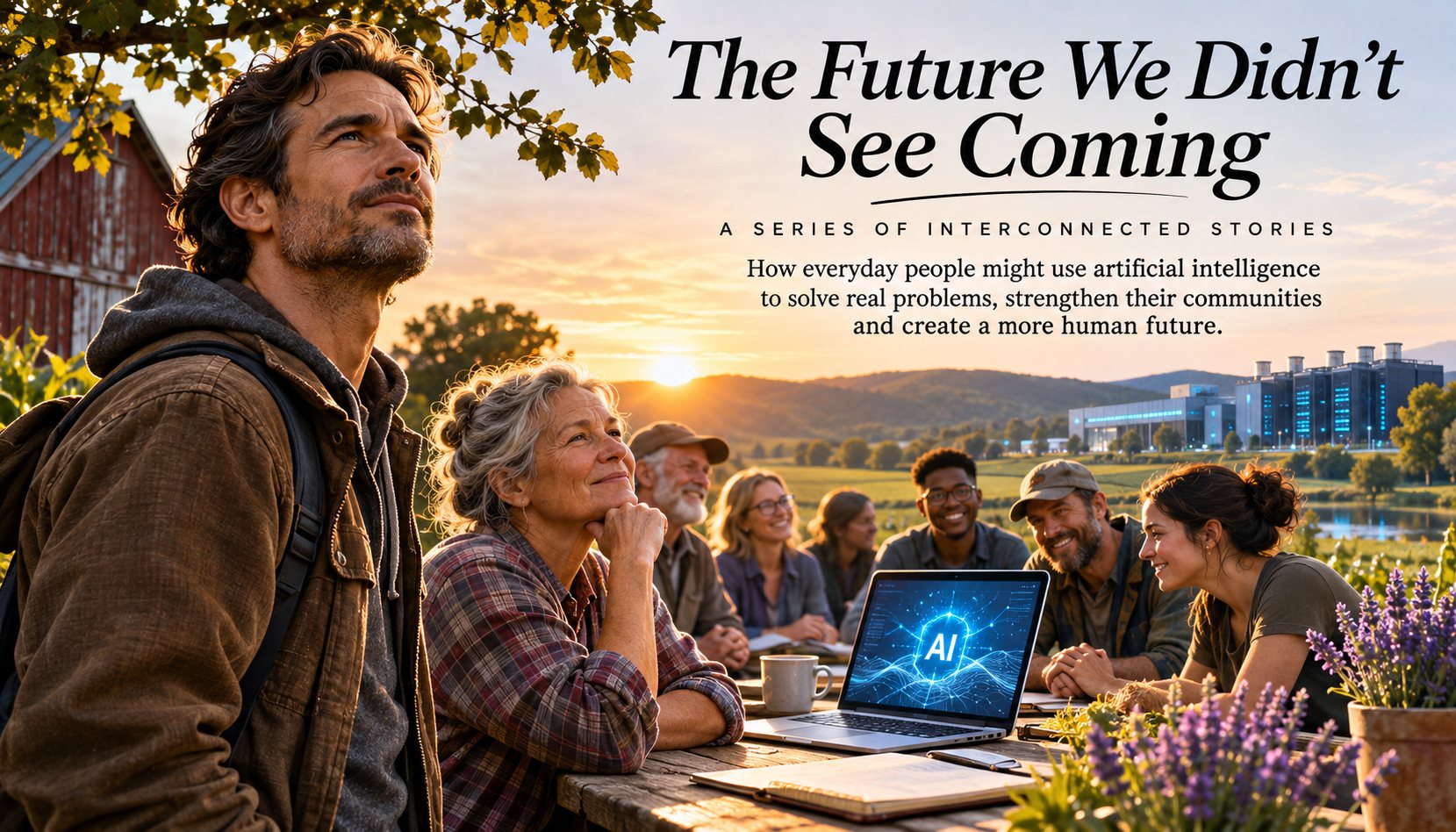
I wanted to explore these possibilities, but rather than beginning with pages of economic research, statistics and historical comparisons, I decided to tell stories.
Stories about ordinary people living through an extraordinary transformation.
- A farmer struggling to keep her land productive as water becomes increasingly scarce.
- A small business owner trying to compete against companies with advertising budgets she could never afford.
- A woman who loses her job and must discover another way to provide for her family.
- A plumber who begins questioning why he needs an employer.
- An entrepreneur who discovers that manufacturing a product no longer requires building an enormous company.
- An investor who begins reconsidering where capital is most productive.
- A corporate executive who discovers that the economic reasoning he applied to his employees might also apply to him.
- And a man who has spent much of his life struggling to find where he belongs, only to discover that his purpose lies in helping others recognize their own potential.
These people will cross paths. Their decisions will influence one another, often in ways they do not recognize. Some will succeed. Some will fail. Some will resist the changes taking place around them.
None of them will have all the answers.
Together, their stories will explore how a community might change when the ability to create, produce and operate independently becomes increasingly accessible.
An exploration, not a prediction
The stories in this series are fictional, but the questions they explore are real.
They are informed by research into agricultural conservation, energy efficiency, technological productivity, business formation, labor economics and the changing advantages of corporate scale.
I am not suggesting that artificial intelligence will inevitably produce a more equitable, sustainable or prosperous society.
There are significant risks. Access to technology could become concentrated. Corporations could consolidate even greater power. People could experience devastating economic displacement. Increased efficiency could lead to increased consumption rather than conservation.
These are futures worth considering, too.
But they are not the only possible futures.
If we spend all our time imagining how artificial intelligence might make our lives worse, we risk overlooking the opportunities to make our lives better.
This series is an invitation to consider another possibility.
The stories ahead
I will release ten interconnected short stories exploring this possible future. The first, The Farmer Who Needed Less Water, is available now.
| Release date | Story |
|---|---|
| Available now | The Farmer Who Needed Less Water |
| December 5, 2026 | The Commercial That Never Needed a Film Crew |
| December 12, 2026 | The Woman Who Lost Her Job |
| December 19, 2026 | The Plumber Who Fired His Employer |
| January 9, 2027 | The Factory With a Thousand Customers |
| January 16, 2027 | The Investor Who Stopped Investing in Corporations |
| January 23, 2027 | The CEO Who Automated Everyone but Himself |
| January 30, 2027 | The AI Company That Chose the Little Guy |
| February 6, 2027 | The Office Building Nobody Needed |
| February 13, 2027 | The Wednesday That Belonged to Nobody Else |
These stories are only the beginning. I will also explore the research behind them, examining which possibilities are supported by existing evidence, which are beginning to emerge and which remain speculative.
I encourage you to challenge the ideas presented throughout this series. Share your questions, your concerns and the possibilities you believe I may have overlooked.
The purpose is not to convince you that artificial intelligence will save humanity. It is to explore what humanity might accomplish with it.
Subscribe for free to follow the series and get new stories, poems and writing by email.
Perhaps the greatest achievement of artificial intelligence will not be that humanity becomes capable of producing more.
Perhaps it will be that we finally need to sacrifice less of our lives to live well.
And perhaps that is the future we didn't see coming.